Advent Greetings to all of you. Here at the monastery we are into our third day of our "Contemplative Days", which are days of silence and a more limited work schedule. These are not so much retreat days as (we do two formal eight day retreats each year) contemplative days in which we have a limited number of guests, we are totally silent, and while we continue to work on projects we have a limited amount of work around the house, no meetings, no retreats to lead, and no spiritual direction. It is good for us to practice what we preach!
Those of you who have been to the monastery know that we sit on a beautiful piece of land right on the Hudson River. It is a gorgeous spot and we are, each and every day, grateful that God has called us to this place. Today, the Hudson River Valley is totally fogged in. The Valley in fog is quite a site to see. It has a kind of mystical appeal that is difficult to describe, but it is one that makes me feel completely at home. It creates a kind of feeling within me that elicits that of being wrapped in a warm blanket, an invitation to sit still, have a cup of hot chocolate, be quiet, and to know that there is a bright shining sun just on the other side of that fog, reveling in the life it fosters and waiting to basked in; or perhaps a moon-lit night hoping for an admirer to look up and fall in love with it's glow and mystery all over again.
I love the sun and the moon and the river and I love when I can see them all in their glory. But I also dearly love the fog because it captures an aspect of my faith life that must be acknowledged. I know the sun and the moon and the river are there but I'm just not always able to see them. Or perhaps, I'm not always allowed to see them. That feels like my experience of God sometimes. I have an incarnate faith and believing very deeply in that Incarnation, it is sometimes just good to sit in the middle of the fog. I know God is there, I just can't always see God.
I think sitting in the fog simply helps us embrace the mystery of a faith that is all about Emmanuel - God with Us - but is equally about a mystery so deep, so imaginative, so foggy, that you need a fog horn to lead you away from danger and toward the home in which you truly belong.
All day long the fog horns have been blowing on the two ships anchored behind the monastery. These are very large freight ships that have been there for a couple of days, and every thirty-seconds they are giving off two five-second blows of the horn in order to ward off any other ships or boats that can not see them. I promise you, these are very large ships, yet the fog is so thick, that this safety precaution is necessary. Living on such a major river thoroughfare, I have certainly seen (heard) this before, but not quite like today.
And all of this racket in the middle of our silence. Frankly, I love it. All that blowing of the horns has begun to make me think of silence as a kind of fog horn. When we have a lifestyle that includes some periods of intentional silence, with a goal of listening for God, that is a tool that can help us to navigate the river of our life. That tool is God's way of helping us to ward off danger, but more importantly, to bring us closer to our home. Closer to safe harbor. Closer to God.
This Advent, I invite you to listen for the fog horn of silence. Sometimes when we can't see, we need to hear. And when we hear, we know that God is near, very near indeed.
Peace be upon you.
Thursday, December 5, 2013

Sunday, December 1, 2013
Swords into Food
Swords
into Food
A Sermon for Advent I
Holy Cross Monastery
West Park, NY
December 1, 2013
West Park, NY
December 1, 2013
 St.
Benedict, in his Rule for monks, is famous for telling us that the
life of a monk should be a perpetual Lent. I would like to hold out
to you the possibility that if Advent had been a fully developed
liturgical season at the time that Benedict wrote his Rule, he might
have taught us that the life of a monk should be a perpetual Advent.
St.
Benedict, in his Rule for monks, is famous for telling us that the
life of a monk should be a perpetual Lent. I would like to hold out
to you the possibility that if Advent had been a fully developed
liturgical season at the time that Benedict wrote his Rule, he might
have taught us that the life of a monk should be a perpetual Advent.
And
here's why: Advent is that season in which we are called to slow down
and quiet ourselves in order to awaken ourselves to a new way of
life, a new and renewed hope in the God of hope, the God with us.
This is, I think, what monastics and those who are inspired by
monastic spirituality do. They wait, they watch, they hope. Most of
all, they hope.
All
of this waiting, watching and hoping is actually quite
counter-cultural which, again, a way of being that is, I believe, the
mark of a healthy monastic community. Quiet down in December? Yes.
Wait, when I've got a million things to do before the holidays? Yes.
Believe that in the days to come there will be peace on earth? Yes.
Salvation is nearer now more than ever? Yes.
Yes.
Yes. Yes. Believing those things is counter-cultural and to be a
Christian, in our country at this current moment in history, demands
of us, that we be counter-cultural. So here, at the beginning of this
blessed season, let us make a commitment to living the life of a
perpetual Advent. As St. Paul calls to us from so many years ago,
this Advent, let us wake from our sleep; and as Jesus calls to us
once awake, we must keep awake. I believe these calls are invitations
to waken ourselves to the hope that Isaiah promises in the days to
come. And that's what I'd like to talk to you about this morning -
that prophesy/hope that Isaiah made in our first reading, one of the
most famous of the season of Advent.
In
particular, I'd like us to focus on what is perhaps the most
well-known verse in the prophesy, verse 4, part of which reads:
...they
shall beat their swords into plowshares,
and
their spears into pruning hooks;
nation
shall not lift up sword against nation,
neither
shall they learn war any more.
When
I have asked people what they think about this particular verse, I
have usually gotten one of three responses. One response is a kind of
“that would be nice, but not going to happen in our life times”;
another is “yes, but what about the Muslims? Or the Soviets? Or
whomever the perceived enemy was at the moment. But the most common
response I have heard over the years, and the most dangerous and
least hope-filled is the cynical response. The one in which the
person says: “Isaiah is a pipe-dream, a naïve and silly approach
to world affairs.” This kind of cynicism leads to some realities on
the ground that make for an especially un-Advent like approach to our
lives.
Because
that kind of cynicism is exactly the kind of cynicism that the hope
of Isaiah, the hope of Advent, the hope of Christ, should make us
reject out of hand. That cynicism is about darkness. And Advent is
nothing, if not about light. The light of hope, the light of Christ
having come among us, the light of Christ coming again, the light of
Christ being right here, right now.
And
each week, as we light one more candle on the Advent wreath, slowly,
but surely, building the light – it is my prayer, my hope, my
expectation, that we will learn what it means to beat swords into
plowshares and spears into pruning hooks. That is what it means, I
think, to wake up and to stay awake. It is to learn how to accept the
invitation from Christ, to be a partner in the building of Christ's
light, Christ's reign.
 And
so what does Isaiah's poetic language mean in real life? Well, to
understand that, I think we must start with with text. Isaiah was
calling to the people to beat swords into plowshares and spears into
pruning hooks not for poetry's sake, but for the sake of food. Plain
and simple.
And
so what does Isaiah's poetic language mean in real life? Well, to
understand that, I think we must start with with text. Isaiah was
calling to the people to beat swords into plowshares and spears into
pruning hooks not for poetry's sake, but for the sake of food. Plain
and simple.
The
constant preparation for war was extremely expensive as it is today.
Swords and spears were among the most expensive weapons of war at the
time and the money that was raised in order to make these weapons
came directly from the people and out of their food budgets. The
people were starving to death so that enough weapons of war could be
made to defend them from being killed by the enemy. This kind of
thinking is what passes for being “realistic” and as a
“sophisticated” understanding of world politics. It is nonsense.
Isaiah
knew that a sword could be reconfigured into a plowshare by a
blacksmith. This is actually something that could be done by any
ordinary blacksmith. A plowshare is that part of a plow that is
sharpened and actually digs the soil in order to create a space where
seeds can be sown. Spears could easily be changed by a blacksmith
into pruning hooks, which could then be used to prune fruit and nut
trees which would provide healthier trees, which would provide more
food. Isaiah knew that a hungry people are a desperate people. Feed
people, grow peace.
So
a less poetic, but perhaps more direct way to relay Isaiah's real
meaning might be: “they shall beat their swords and spears into
food.” Food that nourishes, food that gives life, food that allows
us to continue to build the light. Food for peace. And remember, this
wasn't one-sided. Isaiah says that the nations, plural, will be part
of this movement.
One
other note about the text. The phrase at the beginning of our reading
“in the days to come” is not referring to some magical, mystical,
time in the future when the Messiah brings all this great stuff
about. Rather “in the days to come” refers to real time,
something that will happen in the course of human history, brought
about by the peoples of the earth who seek God.
And
that got me thinking. And so, to continue my own awakening, I did a
little research in the preparation of this sermon. I looked into
hunger in our world today. I'd like to do a little visual experiment
with you today {count off in sixes, the sixth person raises their
hand and keep it in the air}.
Now,
please look all around the church. Every person who has their hand in
the air represents a hungry person in the United States. One in six
persons in the United States, the United States...is hungry.1
They do not have enough food to feed themselves or their families.
These people are not only in the poorest neighborhoods in some
forgotten inner city, though they are there. They are also in nice
neighborhoods in glamorous cities, they are in suburbs, they are in
rural areas, they are, perhaps, right in this church. They are us –
and we are hungry. They are us, but we are at war. Just last year, in
2012, that meant that 49,000,000 people in the United States,
49,000,000 of our fellow citizens were hungry.2
In
Afghanistan, the World Food Program says the number of hungry is
approximately 7,400,000 people who are classified as starving, and
another 8,500,000 people who are classified as facing borderline
starvation.3
This is out of a population of 31,000,000 people.
Around
the world, in the latest figures we have which date back to 2010, the
number of hungry is 870,000,000 people4
I know these are a lot of numbers, and I'm not really a numbers guy,
but I must wake up. We must wake up. Jesus makes it very clear –
wake up.
Please
be patient with me, just one more set of numbers: Since the war in
Afghanistan began in 2001, the United States has spent, as of 5:02
this morning, 677,723,625,603 dollars.5
The website for National Priorities keeps a running ticker as to how
many dollars we are spending on this war. It moves so fast, that it
is difficult to capture any particular dollar amount, but there it
is, as of 5:02 AM – over 677 Billion dollars.
In
those same twelve years, we have spent a little more than 24 Billion
dollars on food aid for the entire planet. So, 677 Billion dollars
for war in Afghanistan alone, and 24 Billion dollars for food all
over the world. That is a lot of swords and spears, and not much
food.
Now
what would it look like if we took a percentage of that money –
let's say even just 10% of it – over 67 Billion dollars – and
spent some of it on emergency food relief and most of it on teaching
people how to grow their own food, how to deal with particular
realities like droughts and floods over the long term, and how to
build infrastructures to make local agricultural efforts more
effective. What would that look like? It would look like we were
building the light of the Advent wreath. What if we used 50% - 339
Billion dollars? The light would be shining so brightly we need cover our eyes and turn away. Peace would be breaking out all over the dinner tables of
the world.
Yes,
Isaiah, and Paul, and Jesus are all about hope. And so am I – at
least on my best days. So here's my hope for myself, my community,
and all of you.
My hope is that:
In
the days to come
the
treasury of our country
will
be used to feed our own people;
to
beat our drones into food for Afghanistan,
and
our nuclear submarines into food for North Korea.
In
the days to come,
the
relative wealth of our monastery
will
be used to feed the people
to
turn our treasure into food for Newburgh, Highland, West Park;
and
to continue to turn our bread into Eucharist for the spiritually
hungry.
If
you came to the monastery, whether as a guest or as a monk to escape
the world, you came to the wrong place. The monastery and monastic
spirituality is not an escape from the world, it is a gateway to the
world. These beautiful sisters and brothers that God has given to us
– sisters and brothers in this church, back home, in Afghanistan,
in North Korea, El Salvador and all around the world, are sisters and
brothers to be fed and to feed us. They are not to be targets of our
swords or spears, our drones or nuclear weapons.
So,
in these Advent days to come, I invite you to hope and hope and hope.
To watch and to wait by learning what it might mean for you to feed a
hungry person, for your community to feed a hungry community, for our
nation to feed another nation. In learning those things, we might
just not have time to learn war anymore. Spend these next several
weeks being quiet enough to learn what it means to build the light in
these days that have come. AMEN.
.jpg)
1
www.feedamerica.org
2Ibid.
3www.wfp.org
4www.worldhunger.org
5www.nationalpriorities.org
Monday, November 25, 2013
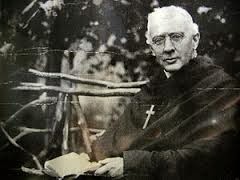
James Otis Sargent Huntington

Most feast days of saints correspond with either the date they died or the next "available" date (one that does not already have a feast associated with it). This is not the case with Father Huntington. He died on June 29th in 1935, and that and that day, already the feast of Saints Peter and Paul is a major red letter day and therefore could not be bumped.
And so the date that was chosen was the anniversary date of Father Huntington's life vows. This was a significant moment not only in our particular history, but in the history of the Episcopal Church, as Father Huntington was the first Episcopal priest to take monastic vows. And so, on this date in 1884, the Order of the Holy Cross was born and with that birth, a new life for many men who would follow Father Huntington into monastic vows, and for so many men and women around the world who have been touched by one of us. It is a day in which to celebrate and to give great thanksgiving for this wonderful man.
We have two fathers in the faith that we look to for inspiration. We are Benedictine monks, and so, of course, we look to St. Benedict, his Rule, and the great 1,500 year tradition that goes with all of that for guidance and inspiration. But St. Benedict is the "Father of Western Monasticism" and one of the most important figures in "Church History". His largeness is both a draw to me as inspiration (I really love being a Benedictine monk) but also a drawback because of intimidation (how am I suppose to relate to the Father of Western Monasticism?).
But Father Huntington is a man I can understand more personally. First of all, even the way I speak of him or to him in prayer, with the words "Father Huntington" is telling. I don't refer to him as Blessed James Otis Sargent Huntington, as he is officially known in "Holy Men, Holy Women", but simply as Father Huntington. That seems to be respectful enough by using the surname for the founder of my Order, while being intimate enough by using the title "Father".
For that is what Father Huntington is to me: a father. I was truly blessed to have in my own father (Joseph, who died back in 2003) a man who really loved me, my siblings and mother; a man who had my best interest at heart; and a man who gave me guiding principles that have lasted me a lifetime. This is the kind of man I imagine Father Huntington to have been.
On his deathbed, Father Huntington promised us that he would always intercede for us. I believe he has and continues to do so. Whenever I feel like I am drifting in my own vocation, I find myself down in our crypt, where Father Huntington is buried, asking him to intercede for me, to help me remain faithful to my monastic vocation. The same is true for our entire Order. Whenever I perceive that we need guidance, direction, or inspiration, I find great hope in Father Huntington's promise to always intercede.
The guiding principle that can probably best sum up Father Huntington's approach to faith is his most famous words:
"Love must act as light must shine and fire must burn."
Love. Light. Fire. Act. Shine. Burn. These are all great words for a monastic vocation and for a life of faith in general. The love that Father Huntington had for God and for God's poor was unbounded. His vision was to "act" in both prayer and service on behalf of the poor whether those people were financially or spiritually (or both) poor. Throughout his life, there was so much light shining from him that it must have seemed like fire to those who encountered him. One of the things I most love about Father Huntington is that he talked about joy a great deal. His understanding of leading a faithful monastic life was that it was based on the love of Christ, prayer, and service and that it would lead to joy.
And he was right. Being a monk is a joyful thing. An incredibly joyful thing. Back in 1884, Father Huntington set in motion a movement here in the United States that has led to my being able to live the life that God most wants me to live - and it is a life of joy. Thank you Father Huntington.
I ask you all to please remember our Order in a special way today in your prayer. Ask our God, if you will, to continue to guide us in our vocation, to send us new vocations (there's lots of interest brewing out there), and to always enable us to live in joy as we become more and more faithful to prayer and service.
And please know that we keep all of you in our prayers each and every day.
Peace be upon you.
Friday, November 22, 2013
And so the War Goes On And On and On

It is very hard to look at these faces. But I hope you will look very closely at them. These are some children from Afghanistan that are hungry and in danger of life-threatening diseases as they sit in a refugee camp displaced by the war in Afghanistan. These children need food. They need health care. They need their families. They need hope. They do not need more war.
But that is what we are going to give them. Here's the latest from NBC, which echoes what many other news outlets have been saying the last few days:
"KABUL – While many Americans have been led to believe the war in Afghanistan will soon be over, a draft of a key U.S.-Afghan security deal obtained by NBC News shows the United States is prepared to maintain military outposts in Afghanistan for many years to come, and pay to support hundreds of thousands of Afghan security forces. The wide-ranging document, still unsigned by the United States and Afghanistan, has the potential to commit thousands of American troops to Afghanistan and spend billions of U.S. taxpayer dollars. The document outlines what appears to be the start of a new, open-ended military commitment in Afghanistan in the name of training and continuing to fight al-Qaeda. The war in Afghanistan doesn’t seem to be ending, but renewed under new, scaled-down U.S.-Afghan terms."
What a surprise. Countries that claim to be Christian are not countries that wage endless war seeking domination of peoples in distant lands. Empires that worship wealth, weapons and war do that. And so the Empire wants to continue to fight an unending war, committing thousands of troops and billions of taxpayer dollars to that effort. And to what end? More refugees. More death. More terrorists. More children sitting with empty soup bowls in their hands.
God offers us tender compassion and calls us to live in tender compassion with one another. The proposed endlessness of this war is offered in your name if you are a citizen of the United States. Our service members are going to be in Afghanistan endlessly getting maimed and killed. Our service members are going to be in Afghanistan endlessly maiming and killing. Our treasure is going to be used to destroy lives and countries and children with soup bowls.
Why don't we organize ourselves into a band of actual Christians calling our leaders to stop endless war and to use all those billions of dollars to feed hungry children and to offer health care to them and to us. That type of Empire is called the Kingdom of God. That's the kind of reign we should be working for. So how do we want to do this? Start by looking long and hard at those faces. God have mercy on us.
Peace be upon you.
Tuesday, November 5, 2013
Shalom

In the beginning of his chapter on the Hebrew word "shalom" he refers to that word as "iridescent" which I just love. He goes on to say, what other scholars have said, that "shalom" has many meanings, but that "well-being, wholeness, [and] completeness" are at the core of its meaning. He goes on to say that the word "ranges over several spheres and can refer in different contexts to bounteous physical conditions, to a moral value, and, ultimately, to a cosmic principle and divine attribute."
I read that chapter sometime last week and have been thinking about it ever since, especially as Election Day approaches. Here in New York State we have local elections today in which people are running for town and county levels offices. There are also a number of state wide ballot questions - some of which have considerable moral import.
But what I want to talk about is shalom in the context of local elections. Many people sometimes think about "peace" as an absence of violence. And that is, in fact, a necessary aspect of having a condition of peace. But peace is much more than an absence of violence. It is having a condition, in a particular location, in which all people share in well-being, wholeness and completeness, to borrow from Swartley. That requires a great deal more than people simply not shooting at each other.
So, what is this condition of well-being. First, that each person have adequate food, clothing, shelter. That each person have adequate health care, access to education, employment. A good question to ask as you prepare to vote might be, "does candidate x have the well-being of all my neighbors at heart, and how about candidate y?"
The first line of opportunity to build peace, that is, to have a condition of shalom, is at the local level. There is a great deal that needs to be done on the national and international fronts as well, but beginning with the local is always the most effective way to build a peaceful community. A community that is iridescent with the colors of shalom.
So, local elections matter. They matter because we get to vote for people who, hopefully, want to put the Scriptural value of shalom into action, without promoting a particular religion, but by promoting non-violence within the community, by promoting care for the poor, the neglected, the young, the elderly, the environment.
So, today, let us pray for all those running for office. And let us pray for those we elect that in their hearts, in their minds, and in their actions, the Scriptural values of shalom will be present and will grow. Let us pray that these women and men understand that their actions, their votes, their way of leading, can build peace or can further destroy it.
Peace be upon you.
Saturday, November 2, 2013
All Souls Day
Today we commemorate All Souls Day, which can be sometimes confusing to folks or disregarded by other folks as some relic of the past. On the most basic level, however, All Souls Day does something, in the context of Christian spirituality, that nearly every other culture and spirituality does: it is a way of remembering our dead loved ones. Even within our own American secular culture, we do this, most especially on Memorial Day, when we remember those who have died defending the nation in war.
But All Souls Day is about more than remembering our loved ones who have died, it is also an opportunity to pray for them and to ask their prayers for us. No, we are not hung up on souls lingering in purgatory, but I think we do have to acknowledge that, since we believe that in death "life has not ended, but changed" the souls of our departed loved ones - indeed all those who have gone before us - might just well need or want our prayers.
I always want and need the prayers of others. That is especially true when facing change of any sort. Change is difficult and fraught with choices that can be confusing even baffling at times. Prayer from others always makes that process easier. So, for me, it follows that if death is not an end, but a continuation of the spiritual journey, all the change that is implied in that journey, is fodder for prayer.
The souls of our loved ones who have died, and eventually our own souls, will continue to make that journey toward the light, the Light that is Christ. We are, in fact, in a continuing community of all the living and the dead. Praying for, and asking the prayers of our beloved dead, is one of the most basic human and spiritual things to do.

But All Souls Day is about more than remembering our loved ones who have died, it is also an opportunity to pray for them and to ask their prayers for us. No, we are not hung up on souls lingering in purgatory, but I think we do have to acknowledge that, since we believe that in death "life has not ended, but changed" the souls of our departed loved ones - indeed all those who have gone before us - might just well need or want our prayers.
I always want and need the prayers of others. That is especially true when facing change of any sort. Change is difficult and fraught with choices that can be confusing even baffling at times. Prayer from others always makes that process easier. So, for me, it follows that if death is not an end, but a continuation of the spiritual journey, all the change that is implied in that journey, is fodder for prayer.
The souls of our loved ones who have died, and eventually our own souls, will continue to make that journey toward the light, the Light that is Christ. We are, in fact, in a continuing community of all the living and the dead. Praying for, and asking the prayers of our beloved dead, is one of the most basic human and spiritual things to do.

So, let us pray for our dead and let us ask them for prayers as well. They are part of our community, grounded, as it were, in Christ. May the light of the prayers of the entire community lead you, and all your loved ones, to the Light.
Thursday, October 31, 2013
All Hallows

I suppose I just wanted to say that because this time of year, and it was no different this year, we often hear a good deal of ridiculous talk from various Christian leaders across the evangelical-catholic spectrum, who are way too concerned about the "evils" of Halloween. Let the kids have fun. Let the adults have fun too! Who doesn't like an excuse to eat a few pieces of candy?
But when you really delve into where Halloween, or All Hallows Eve, comes from you learn that, sure it has pagan roots (so does the Christmas tree, the Easter egg and a whole lot of other things we have convinced ourselves are Christian), but it is deeply embedded into a Christian way of understanding the mystery of death, which, for us, is deeply connected with the mystery of life. The living and the dead live in an on-going community called the Communion of Saints. All Hallows Eve is essentially the vigil of that feast we call All Saints and is a way of commemorating the waiting that is the hallmark of the Christian faith.
Sure the way Halloween is celebrated in the secular world does not reflect much of this, but neither does the way the secular world celebrate Christmas reflect the religious nature of the holiday - and no one is calling for the banning of Christmas. Enjoy those few pieces of candy, admire the really creative costumes you might see, and thank God that God keeps us in communion with all the living and the dead in the unity of Christ. It is a great gift that celebrates all of life in its various manifestations. Happy All Hallows.
Subscribe to:
Posts (Atom)